Reinventing real-time streaming with WebRTC!
SAVER
TECHNOLOGY


SAVER FEATURE
The leading share of the
WebRTC field in Japan
Saver’s WebRTC solutions cover system integration
end to end, from building the infrastructure
through to developing the UI
What is WebRTC?
High-quality technologyHigh Quality
We are uncompromising about raising the quality of audio and video, and we use state-of-the-art technology to keep delivering a clear, vivid sound and picture experience. We make active use of techniques that improve quality in real-time communication, such as WebRTC and codec optimization.
InfrastructureInfrastructure Construction
Using the major cloud services - AWS, Google Cloud, Oracle Cloud and others - we build the cloud infrastructure best suited to your needs and your industry. By providing a secure, scalable environment we make stable service operation possible.
UI developmentUI Development
Since our founding, mobile UI/UX development has been our strength, and we support UI design and development for remote solutions across a wide field: remote work, remote healthcare, IoT and more. We take care to deliver an intuitive, easy-to-use interface seen from the user’s point of view.
The right technology for real-time communication
Provision Of Technology










We deliver our technology in many forms
Building the complete system
Embedding it in your system as core software
Customizing it to your requirements
Proposing the solution that best fits the nature,
schedule and budget of the system







High-quality, highly stable
WebRTC live streaming technology
VIDEO DISTRIBUTION
- 4K streaming supported
- Streaming at the resolution you specify
- Selecting the best codec
We have established the technical foundation for delivering video over a network
properly,
efficiently and reliably

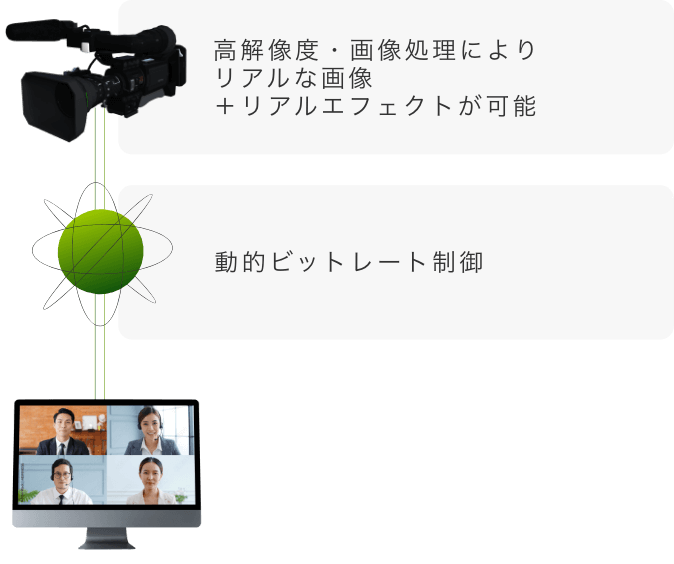
Lifelike pictures through high resolution and image processing, plus real-time effects
Dynamic bitrate control
▶︎ Properly…
lifelike pictures
4K supported
A range of image processing is possible: hue, saturation, shake correction, distortion correction, noise reduction and more
A wide variety of effects can be composited onto a video file in real time: speech bubbles on a subject in the footage, and effects that respond to what changes in the video.
▶︎ Efficiently and reliably…
keeping picture quality even when the connection is poor
By applying dynamic bitrate control to the outgoing video according to the use case, we keep the picture as natural as possible even when the connection degrades. The table below gives examples of how we tune it.
Examples of bitrate control
| Use case | Control method (example) |
|---|---|
| Presentations of text, drawings or line art, e.g. in a web conference |
Keep the resolution, lower the frame rate |
| Video where motion matters - sport, film or video games |
Keep the frame rate, lower the resolution |
| Video content without much fast motion | Lower frame rate and resolution in balance |
Clear, noise-resistant
WebRTC audio streaming technology
HIGH-QUALITY SOUND
- Adopting and implementing the best codec for the use case
- Tuning down to the most delicate sounds

Adopting and implementing the best codec for the use case
WebRTC generally uses an audio codec called Opus.
Other audio codecs such as G.711 and G.722 can also be used.
| Codec | Sample Rate | bit rates |
|---|---|---|
| Opus | 8,000 Hz- 48,000 Hz | up to 510 kbps |
| G.711 | 8,000 Hz | 64 kbps |
| G.722 | 16,000 Hz | up to128 kbps |

Tuning down to the most delicate sounds
We adopt and implement the codec best suited to the use case.
From immersive live sound to delicate sounds such as a stethoscope, we select and tune the codec and stream it clearly.


Ultra-low-latency WebRTC technology
with response under 100 msec
ULTRA LOW LATENCY
- Minimizing each processing time across devices and network
- Minimizing latency by reworking the processing flow
- Optimal interface design and codec selection
01Capture and video transmission system

02Network transmission
03Video receiving and rendering system
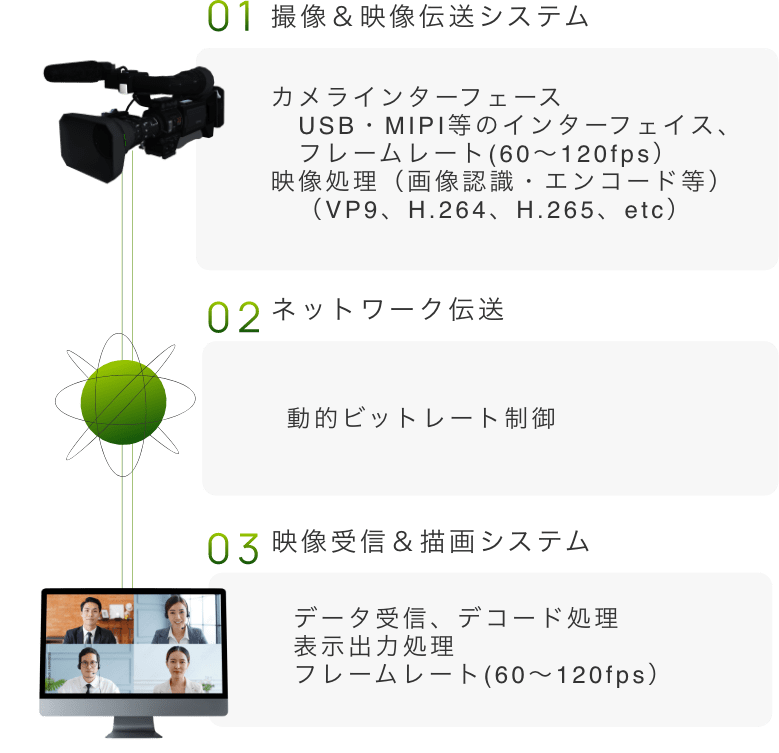
Camera interface
interfaces such as USB and MIPI,
frame rate (30-60 fps)
video processing (image recognition, encoding, etc.)
(VP8, VP9, H.264, H.265, etc.)
Dynamic bitrate control
Data reception and decoding
display output
frame rate (30-60 fps)
Minimizing each processing time
Measuring the various processing (latency) times across devices and network, and minimizing each of them
Minimizing latency
Minimizing latency by reworking
and optimizing the processing flow (minimizing buffering and so on)
Optimal interface design
and codec selection
Optimal interface design and codec selection: we design to minimize the above from both the hardware and the software side.
Glass to glass latency as low as 100 msec
A WebRTC solution for real-time
video editing, compositing
and streaming
LIVE VIDEO
- Compositing several live video feeds and streaming them
- Switching, editing and streaming from several live video feeds
- Auto-scaling
We have established the technical foundation authoring requires,
including video recognition and processing
Video relay system diagram
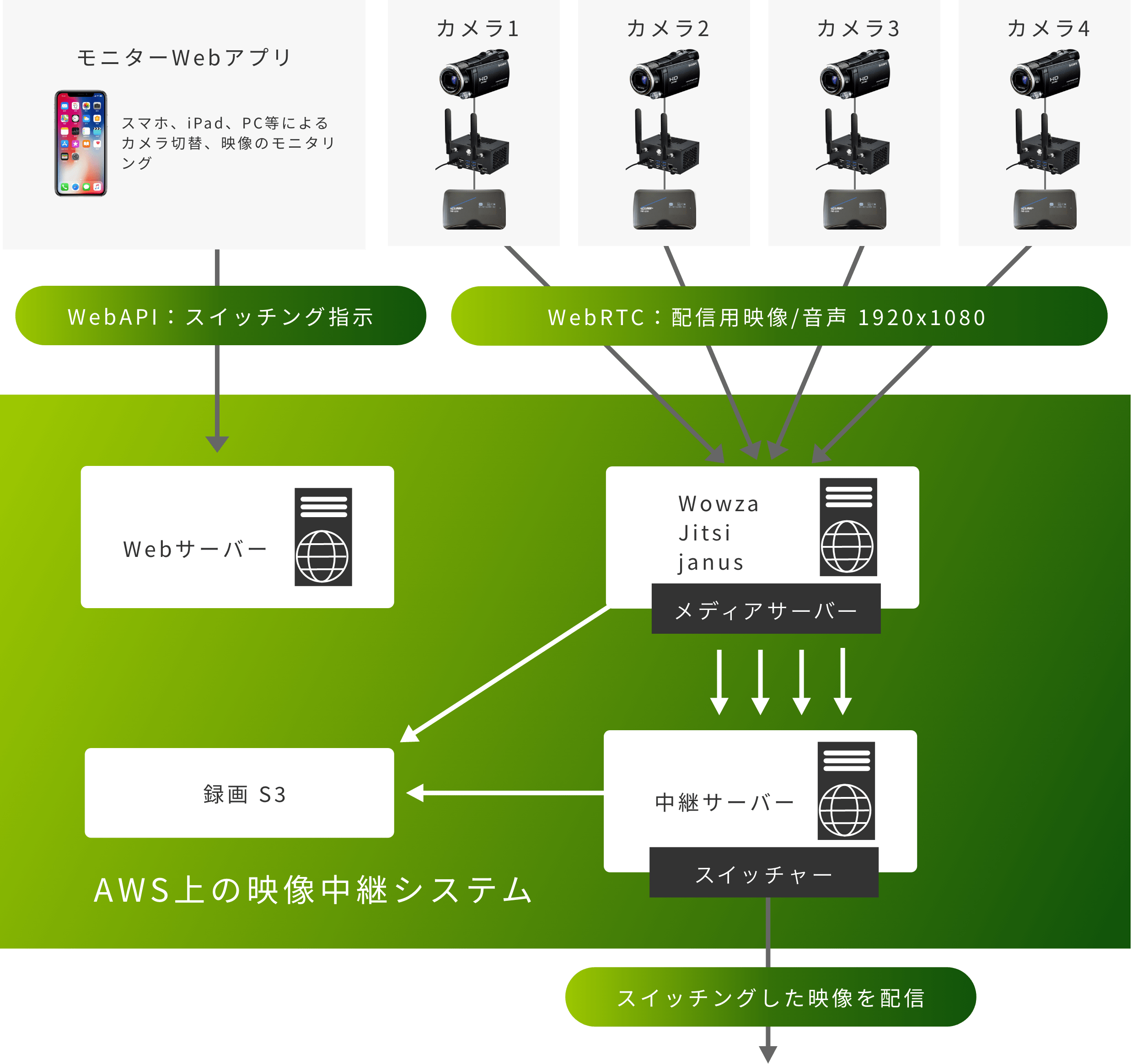
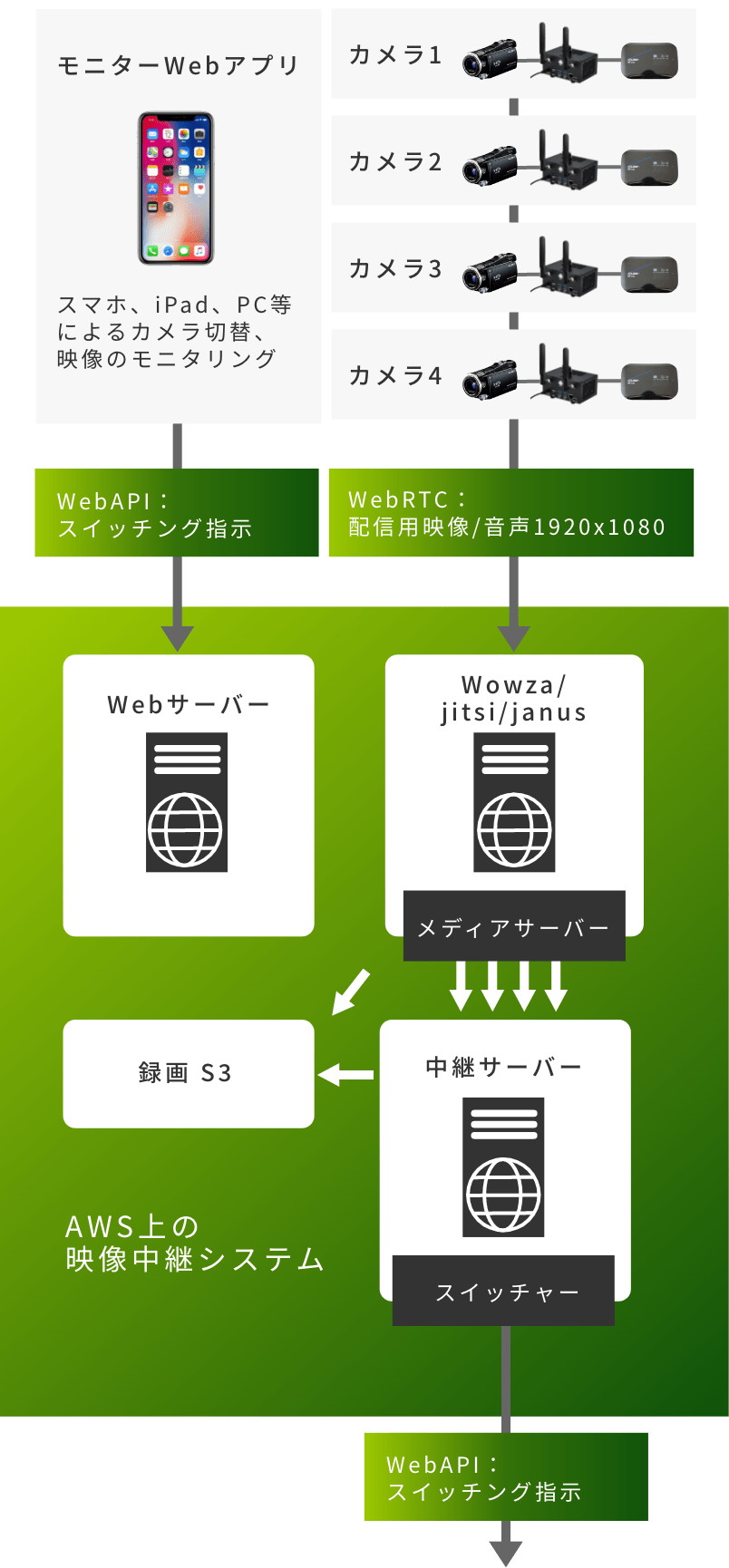

YouTube streaming
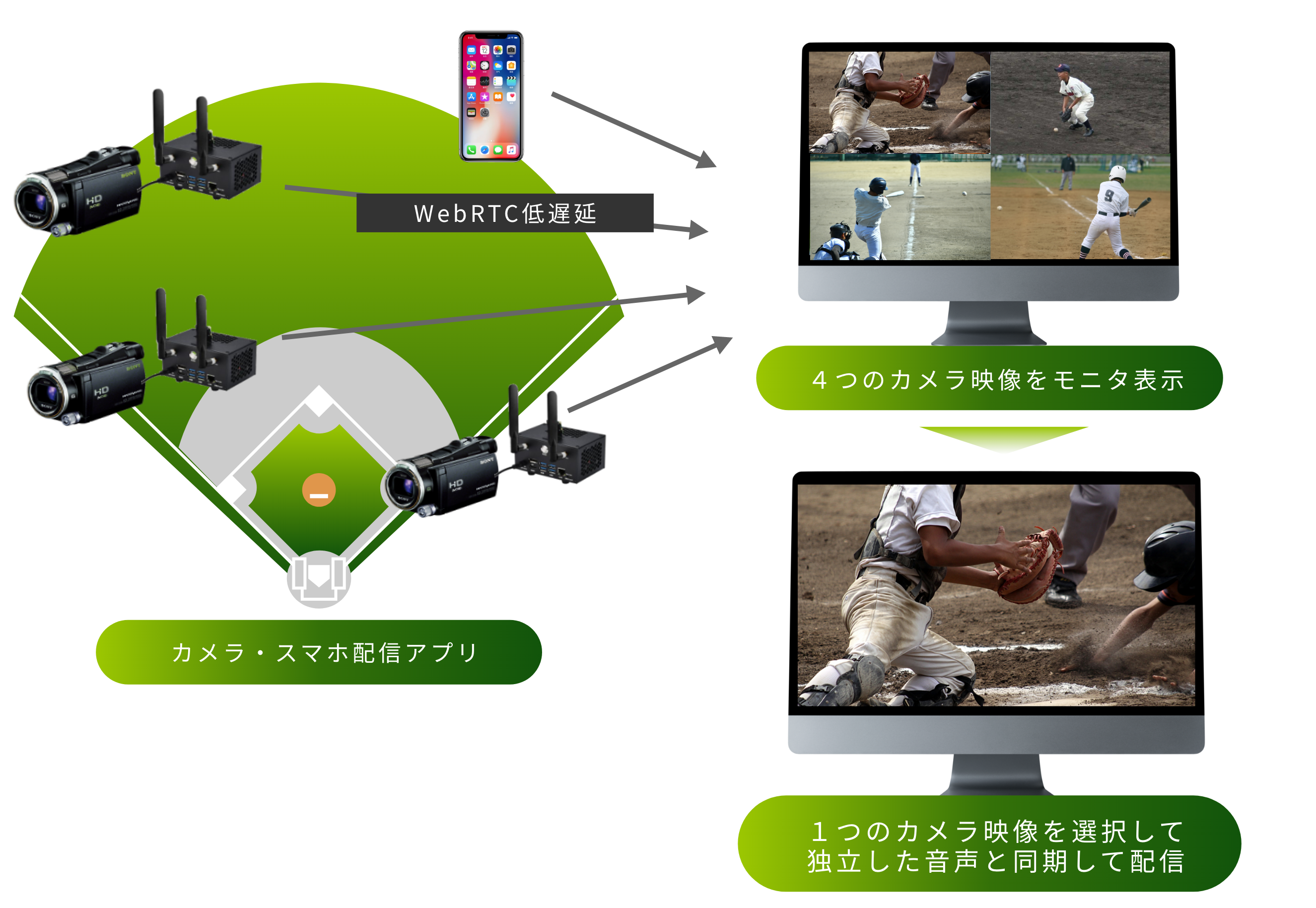
Relay system app (monitoring / switcher)
Switching, editing and streaming from several live video feeds
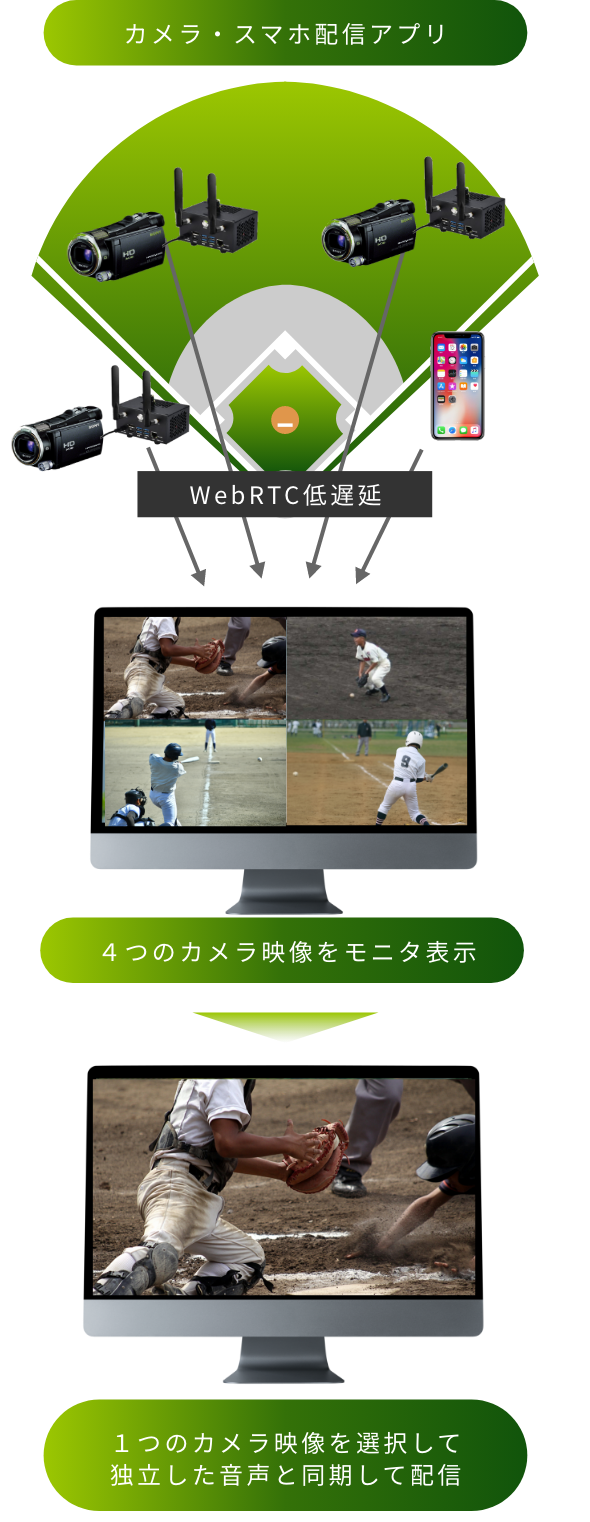
Relay system app (other features)

Composite onto the stream
Composite captions, images and dynamic web app pages onto the stream

Recording
Save the stream in real time

Playback streaming
Specify any video and stream it back

Replay and edit
While streaming, cut any few dozen seconds out of footage from minutes ago to replay it and change the playback speed

Highlight playback
Combine replay clips and play them as a list

Multi-tenant
Create company and user accounts to offer the service per company. *Payment processing is not included.

Booking
The server starts automatically at the booked time and is provided to the company, then shuts down automatically when the booking ends
Highly scalable
WebRTC system construction technology
CLOUD CONSTRUCTION
- Scale the number of processing modules up and down with the system load, for a system with nothing wasted
Scale the number of processing modules up and down with the system load,
for a system with nothing wasted
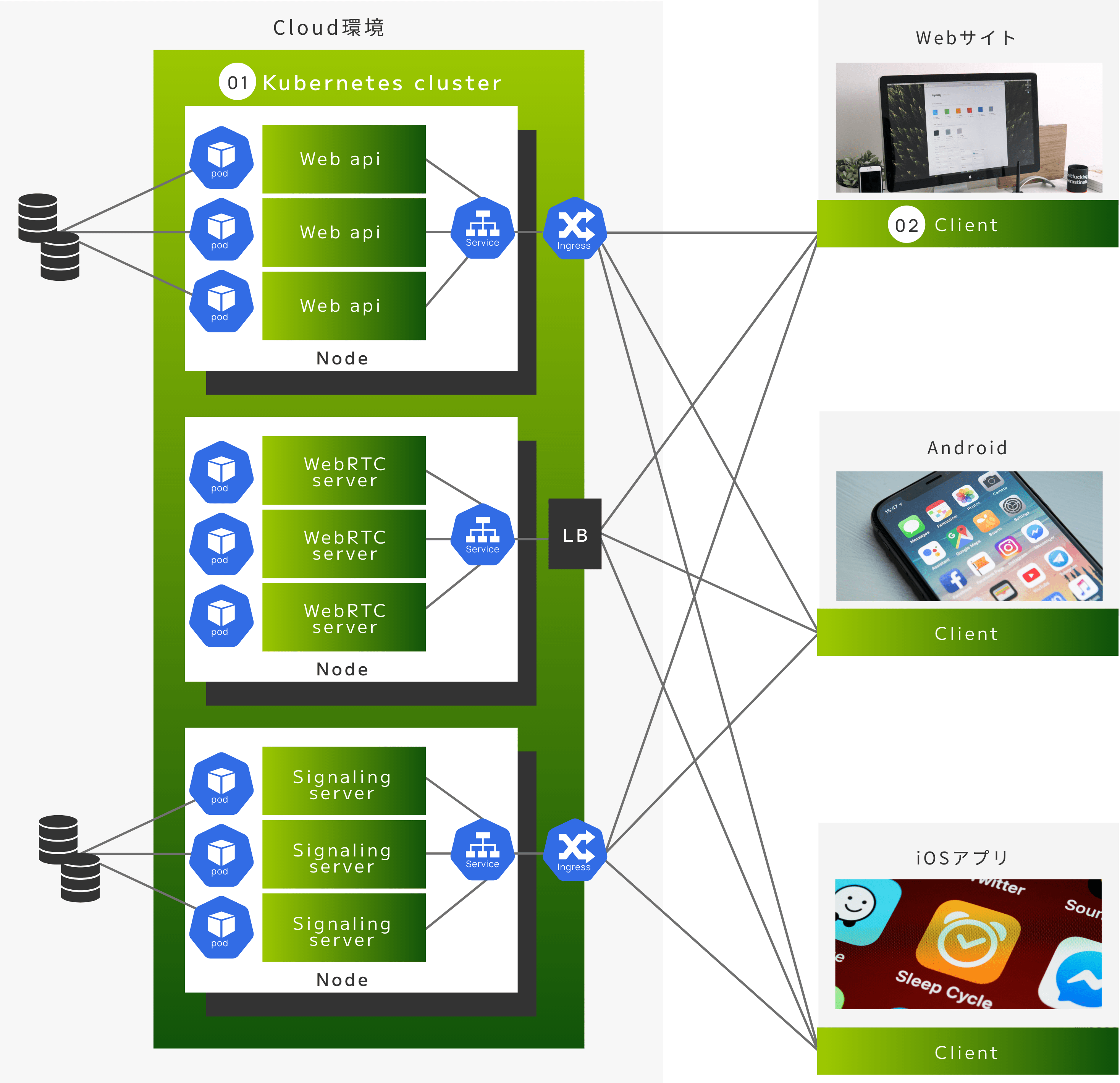
We build a Kubernetes environment in the cloud, and each module of the system starts as a Pod. The number of nodes and pods scales automatically with load, so system resources are used without waste.
A range of clients can connect: web browsers, Android apps, iOS apps and more. A client can use the system without having to be aware of what processing is running, or how much of it.
WebRTC system development
technology shaped to your needs
SYSTEM DEVELOPMENT
- Improving and optimizing system performance
- Optimizing the network configuration
- Guaranteeing scalability
- Securing the system
Improving and optimizing
system performance
From measurements of processing time across software and hardware we examine processing delays and uneven load, then rework the processing flow and distribute load so that each delay is as small as possible, maximizing system performance

Optimizing the
network configuration
We identify the communication requirements at application level and design load balancing around them.

Better connectivity through
dynamic bitrate control
We control the file size of the outgoing video to match the network environment. This reduces buffering and loading delay for the viewer, so playback is interrupted less often.

Guaranteeing scalability
Building an auto-scale-out environment

Securing the system
Security design covering the main information paths and the devices that access them
Formats and languages we work with
Codec
H.264, H.265, VP8, VP9, Opus, G.711, G.722 and others
Protocol
WebRTC, RTMP, RTP, HLS and others
Languages
Python, PHP, C, C++,
C#, Swift, Java, JavaScript, React, Go and others
The next-generation solution for WebRTC video streaming
SaverVideoConnectV4

A system built with everything
Saver knows about
video streaming technology
Lower latency and greater versatility in sending and receiving video and audio!
WebRTC used to its full potential - everything Saver knows about video streaming poured in.
Learn more